
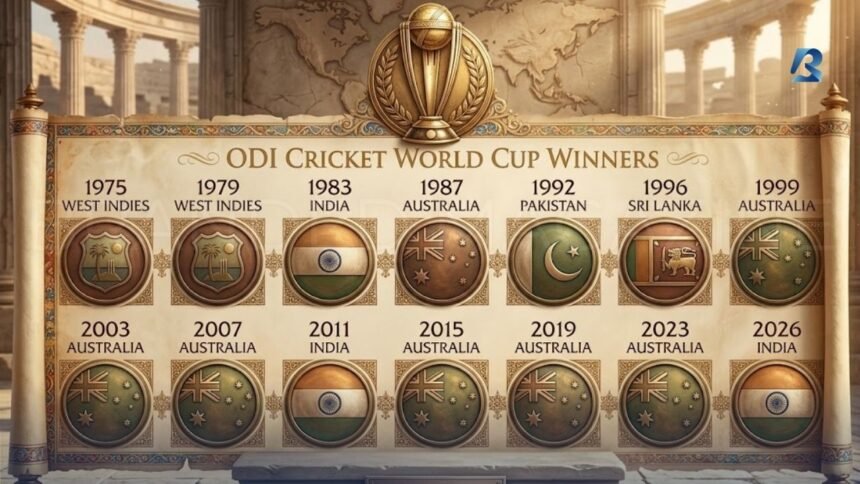
The men’s ODI Cricket World Cup has been won by six different teams across its 13 completed editions. Australia leads the standings with six championships, while the West Indies and India have each won twice. Pakistan, Sri Lanka, and England have each claimed one title.
The following table lists every champion and runner-up from the inaugural tournament in 1975 through the 2023 edition.
| Year | Winner | Runner-up | Final result |
|---|---|---|---|
| 1975 | West Indies | Australia | Won by 17 runs |
| 1979 | West Indies | England | Won by 92 runs |
| 1983 | India | West Indies | Won by 43 runs |
| 1987 | Australia | England | Won by 7 runs |
| 1992 | Pakistan | England | Won by 22 runs |
| 1996 | Sri Lanka | Australia | Won by 7 wickets |
| 1999 | Australia | Pakistan | Won by 8 wickets |
| 2003 | Australia | India | Won by 125 runs |
| 2007 | Australia | Sri Lanka | Won by 53 runs |
| 2011 | India | Sri Lanka | Won by 6 wickets |
| 2015 | Australia | New Zealand | Won by 7 wickets |
| 2019 | England | New Zealand | Tied match; England won on the boundary-countback rule |
| 2023 | Australia | India | Won by 6 wickets |
Which Country Has Won the Most ICC World Cups?
Australia is the most successful team in men’s ODI World Cup history, with six titles. Its championships came in 1987, 1999, 2003, 2007, 2015, and 2023. The team also holds the distinction of winning three consecutive editions between 1999 and 2007.
India and the West Indies are tied in second place with two titles each. The West Indies won the first two tournaments in 1975 and 1979, while India lifted the trophy in 1983 and 2011. Pakistan won in 1992, Sri Lanka triumphed in 1996, and England became champions in 2019.
Australia’s sustained success reflects its ability to combine experienced leadership with talented batters, fast bowlers, effective spinners, and excellent fielding. Its victories across different eras also demonstrate how teams can adapt to changing conditions and tournament formats.
Although India has won fewer titles, its World Cup victories have had an enormous cultural impact because of cricket’s popularity in the country. The West Indies, meanwhile, remain closely associated with the early years of the competition, when their powerful team established a standard that other nations sought to match.
Memorable Moments in ICC World Cup History
India’s 1983 Triumph
India’s victory in 1983 remains one of the tournament’s most influential stories. The team defeated a West Indies side that had won the previous two editions, despite defending a total of just 183 in the final. The result transformed India’s international reputation and helped strengthen the popularity of cricket throughout the country.
Pakistan’s Comeback in 1992
Pakistan’s journey to the 1992 championship is remembered for the team’s recovery after a difficult start. Led by Imran Khan, Pakistan found form as the tournament progressed and defeated England in the final in Melbourne. Wasim Akram’s decisive bowling performance helped turn the match in Pakistan’s favour, completing a landmark achievement for the nation.
Australia’s Three Consecutive Titles
Australia’s championships in 1999, 2003, and 2007 created one of the greatest periods of dominance in international cricket. The team combined aggressive batting with disciplined bowling and strong tactical planning. Its 2003 final victory over India, featuring Ricky Ponting’s unbeaten 140, was especially emphatic.
India’s 2011 Home Victory
The 2011 final brought India and Sri Lanka together in Mumbai. Sri Lanka scored 274 for six, with Mahela Jayawardene making an unbeaten century. India successfully chased the target, supported by Gautam Gambhir’s 97 and captain MS Dhoni’s unbeaten 91. Dhoni finished the match with a six, securing India’s second ODI World Cup title on home soil.
England and New Zealand’s Dramatic 2019 Final
The 2019 final at Lord’s became famous for its extraordinary finish. England and New Zealand both scored 241 in their 50 overs. The Super Over also ended in a tie, and England were awarded the championship under the boundary-countback rule used at the time.
The result sparked extensive discussion about tie-breaking rules in cricket. It also highlighted how a single match can produce a lasting debate even after the trophy has been awarded.
Australia’s Comeback in 2023
The 2023 final took place in Ahmedabad, where India faced Australia in front of a huge crowd. India scored 240, but Australia recovered from early setbacks through a composed batting performance. Travis Head scored 137, guiding Australia toward a six-wicket victory and a record-extending sixth title. ICC
Greatest Players in ICC World Cup History
The World Cup has showcased some of the most influential players in cricket. Their performances have helped define tournaments, inspire younger generations, and create records that remain central to the competition’s history.
Sachin Tendulkar is one of the most celebrated players in World Cup history. The Indian batter was a key figure across multiple editions and holds the record for the most runs scored in men’s ODI World Cup history. His performances in 1996, 2003, and 2011 helped establish his reputation as one of cricket’s greatest batters.
Ricky Ponting played a major role in Australia’s dominance during the 2000s. As captain, he led Australia to titles in 2003 and 2007. His unbeaten 140 in the 2003 final against India remains one of the most significant innings in a World Cup final.
Kapil Dev became a national sporting icon after captaining India to its first title in 1983. His leadership and all-round ability were central to India’s successful campaign, which changed expectations for the national team.
Imran Khan led Pakistan to its only men’s ODI World Cup title in 1992. His leadership, combined with the skills of players such as Wasim Akram and Inzamam-ul-Haq, helped Pakistan overcome difficult opponents during the tournament.
MS Dhoni captained India to victory in the 2011 final. His unbeaten innings and match-winning six made the final one of the defining moments of his international career.
Travis Head became a central figure in Australia’s 2023 victory after scoring a century in the final. His innings helped Australia defeat the host nation and secure its sixth championship.
Important ICC World Cup Records
World Cup records offer a way to compare players and teams across different generations. However, statistics should be understood in context because the number of teams, playing conditions, and tournament formats have changed over time.
| Record | Player or team | Achievement |
|---|---|---|
| Most men’s ODI World Cup titles | Australia | 6 titles |
| Most runs in World Cup history | Sachin Tendulkar | 2,278 runs |
| Most runs in a single edition | Virat Kohli | 765 runs in 2023 |
| Highest individual score in a men’s ODI World Cup match | Martin Guptill | 237 not out in 2015 |
| Most wickets in World Cup history | Glenn McGrath | 71 wickets |
| Most wickets in a single edition | Mitchell Starc | 27 wickets in 2019 |
Records listed above refer to the men’s ODI Cricket World Cup and are not interchangeable with ODI career records or T20 World Cup statistics. Individual records can be checked against the ICC’s historical records and tournament archives.
Australia’s six championships remain the most prominent team record. At the individual level, Virat Kohli’s 765 runs in the 2023 edition set a new record for the most runs scored by a batter in a single men’s ODI World Cup. Glenn McGrath’s 71 career World Cup wickets illustrate the long-term value of consistency and accuracy in tournament cricket ICC.
Famous Rivalries in the Cricket World Cup
Rivalries add another layer of excitement to the tournament. India versus Pakistan matches attract extraordinary attention because of the sporting history and passionate fan bases associated with both teams. Their World Cup encounters are often among the most closely watched matches of an edition.
Australia versus England is another historic rivalry. The two teams met in the final of the inaugural tournament in 1975, and England again faced Australia in several important finals, including in 1987. Their encounters often feature contrasting styles, intense competition, and significant consequences for the tournament.
India versus Australia has also produced several memorable matches, including the 2003 and 2023 finals. India’s victory in the 2011 final and Australia’s success in 2023 demonstrate how the balance between the two teams has shifted across different generations.
New Zealand has developed a reputation for resilience in World Cup knockout matches. Although the team has not won the men’s ODI World Cup, its runs to the finals in 2015 and 2019 demonstrated its ability to compete with cricket’s most established powers.
ICC World Cup Format and Qualification Explained
The men’s ODI World Cup uses the 50-over format. Each team gets one innings, with a maximum of 50 overs, unless the innings ends earlier because all batters are dismissed or another match condition applies. The side scoring more runs wins, subject to the competition’s playing conditions and any applicable rain rules.
The tournament structure has changed several times. Earlier editions featured different group arrangements, Super Six or Super Eight stages, and varying numbers of participating teams. The 2019 and 2023 tournaments each featured ten teams in a round-robin league, followed by semi-finals and a final.
Qualification depends on the rules established for each edition. Rankings, qualifying competitions, and other qualification pathways can determine which national teams earn places in the final tournament. Readers looking for the next edition’s qualification process, participating teams, or fixtures should consult the ICC’s official tournament pages, since these details can change between cycles.
The Role of the ICC in International Cricket
The International Cricket Council is the global governing body for international cricket. It oversees major international tournaments, including the men’s ODI World Cup, and establishes competition regulations in coordination with the relevant cricket authorities.
For the World Cup, the ICC coordinates tournament planning, qualification requirements, playing conditions, officials, and other essential arrangements. It also maintains official results, statistics, rankings, and historical information. These resources help fans, journalists, analysts, and researchers verify match outcomes and player achievements.
Official ICC records are particularly useful when checking current schedules or historical statistics. Secondary websites can provide helpful analysis and context, but official tournament pages should be used to confirm results, team lists, and changes to upcoming competitions.
How the Cricket World Cup Has Changed Over Time
The World Cup has evolved considerably since 1975. The inaugural tournament featured eight teams playing 60-over matches with red balls. Over time, the competition adopted 50-over innings, coloured clothing, white balls, improved broadcasting, and more sophisticated match analysis.
Technology has also changed how fans experience the tournament. Television coverage, high-definition broadcasts, digital scorecards, and online highlights make it easier for audiences worldwide to follow games. Decision-review technology and advanced performance data have also influenced the way players, coaches, and officials assess crucial moments.
Tournament formats have expanded and contracted as the ICC has balanced competitiveness, scheduling, commercial interests, and opportunities for emerging teams. These changes reflect the challenge of maintaining a global championship that is both entertaining and competitive.
Despite these developments, the central objective remains the same: bring together the world’s leading ODI teams and determine a champion through high-level international cricket.
What Makes the ICC World Cup Special?
The ICC Men’s Cricket World Cup stands apart because it combines national pride, elite competition, and the unpredictability of knockout sport. A tournament may last several weeks, but one outstanding innings, a crucial spell of bowling, or a brilliant fielding effort can change its direction.
For players, winning the World Cup can become a defining achievement. For supporters, it can create memories shared across families and generations. The victories of India in 1983 and 2011, Pakistan in 1992, Sri Lanka in 1996, and Australia across six editions show that the championship has produced defining moments for several cricketing nations.
The tournament also gives established teams a chance to protect their reputations while allowing less-favoured sides to challenge expectations. That combination of history and uncertainty keeps the competition relevant to longtime followers and newer fans alike.
Conclusion
The ICC World Cup has grown from an eight-team competition in 1975 into one of the most recognised championships in international cricket. Its history includes West Indies dominance, India’s breakthrough victories, Pakistan’s remarkable 1992 campaign, Sri Lanka’s rise in 1996, England’s dramatic 2019 triumph, and Australia’s record six titles.
The tournament’s legacy is built not only on trophies but also on extraordinary individual performances, intense rivalries, and moments that changed how fans remember the game. From Clive Lloyd’s century in the first final to Travis Head’s decisive innings in 2023, the World Cup continues to provide a stage for cricket’s greatest stories.
As the next editions approach, the history of the men’s ODI World Cup offers useful context for understanding its champions, records, and evolving format. For the most accurate upcoming fixtures, qualification details, and official statistics, readers should refer to the International Cricket Council’s website.
Frequently Asked Questions
What is the ICC World Cup?
The ICC Men’s Cricket World Cup is the international championship for men’s 50-over One Day International cricket. It is organised by the International Cricket Council and usually takes place every four years.
Which country has won the most ICC Men’s Cricket World Cups?
Australia holds the record with six titles, won in 1987, 1999, 2003, 2007, 2015, and 2023.
Who won the first ICC Cricket World Cup?
The West Indies won the inaugural tournament in 1975. Led by Clive Lloyd, they defeated Australia by 17 runs in the final at Lord’s in England.
How many times has India won the men’s ODI World Cup?
India has won the men’s ODI World Cup twice, in 1983 under Kapil Dev and in 2011 under MS Dhoni.
Who won the ICC Men’s Cricket World Cup in 2023?
Australia won the 2023 tournament by defeating India by six wickets in the final in Ahmedabad. Travis Head scored 137 runs in the match.
Who won the 2019 Cricket World Cup?
England won the 2019 men’s ODI World Cup after the final and Super Over against New Zealand both ended in ties. England were declared winners under the boundary-countback rule used at that time.
Is the ODI World Cup the same as the T20 World Cup?
No. The ODI World Cup uses 50 overs per side, while the T20 World Cup uses 20 overs per side. They are separate competitions with different histories and records.
Stay More Update BRANDED MAGAZINE